Contents
What actually matters in a charger
Ignore slot count and blinking lights for a second. Five things separate a charger that makes your cells last 5+ years from one that kills them in months:
1. Independent slots (not paired)
A good charger makes a separate decision for every single cell - start, monitor, and stop each one on its own. Cheap chargers wire slots in pairs and terminate on the pair, which over-charges one cell and under-charges the other whenever they aren't perfectly matched. This is the number-one thing to check. All our picks below charge every slot independently.
2. Proper termination (this is what “smart” means)
NiMH cells (your AA/AAA rechargeables) don't have a hard voltage ceiling like lithium. A smart charger detects the tiny voltage dip that happens the instant a cell fills - called −ΔV (minus-delta-V) - usually backed up by a temperature sensor and a safety timer. A “dumb” charger just pushes current for a fixed time and hopes. That's how batteries get cooked.
3. Charge current matched to the cell - the 0.5C-1C rule
“C” is the cell's capacity. A 2000 mAh AA at 1C means 2000 mA. Charge NiMH somewhere between 0.5C and 1C (roughly 1000-2000 mA for that AA). Too fast overheats the cell and shortens its life; too slow and the −ΔV dip gets too small to detect reliably, so the charger may never shut off. The best chargers let you pick the current - and you drop it for tiny AAA cells.
4. The right chemistry - and never the wrong one
NiMH and Li-ion charge completely differently (NiMH uses −ΔV; Li-ion uses constant-current/constant-voltage to a hard 4.2 V cutoff). Never charge a lithium cell in a NiMH-only charger, or vice-versa. Multi-chemistry chargers auto-detect and switch; single-chemistry ones don't and shouldn't be forced.
5. Bonus features worth paying for
Once the fundamentals are covered, the extras that genuinely help: an LCD showing per-slot voltage/current; a capacity/analyze mode that discharges then recharges to report the cell's true mAh (the only way to spot a worn-out cell); a refresh/break-in mode to recover or condition cells; and USB-C input so you can run it off a power bank.
The chargers to avoid
- Free “dumb” chargers that come bundled with cheap battery packs - timer-based, no −ΔV cutoff. The fastest way to ruin NiMH cells.
- Ultra-cheap “fast” chargers that blast high current with poor termination. Heat is the enemy; these bake cells.
- Paired-slot chargers (must insert cells 2 or 4 at a time, share one decision). Bad for mismatched cells, and they hide per-cell info.
- No-name / unbranded units with no listed termination method. If it doesn't say how it decides a cell is full, assume it doesn't.
Best simple/smart AA-AAA charger
For most people this is the whole story: a reliable smart charger for household AA/AAA NiMH. All three Panasonic Eneloop chargers below use true individual charge control - mix AA and AAA, different capacities, and different charge levels in any combination of 1-4 cells.
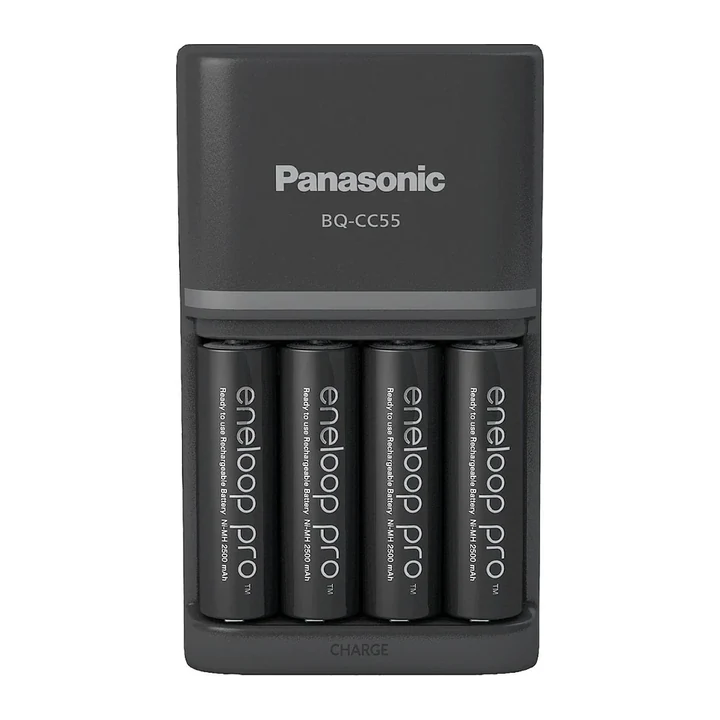
Panasonic Eneloop BQ-CC55 “Smart & Quick”
~$20-27BQ-CC55 · 4 independent slots · AA/AAA NiMH
The community default. Four independent slots, genuinely quick (about 90 minutes for 2 AA Eneloop) without being so aggressive it damages cells. Each slot has a three-colour LED so you can see charge state at a glance. No LCD, no USB - just does the core job reliably, which is exactly what most households need.
Pros
- True independent slots + reliable −ΔV termination
- Fast but not cell-damaging
- Cheap, reliable, widely available
Cons
- No LCD / no capacity readout
- No USB-C input
- AA/AAA NiMH only (no Li-ion, no C/D)
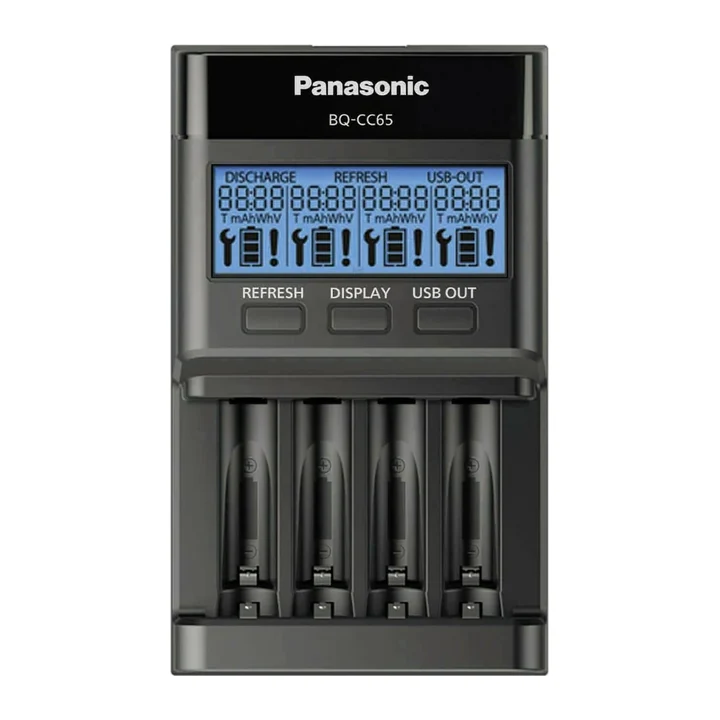
Panasonic Eneloop BQ-CC65 - if you want data + USB out
~$35-45BQ-CC65 · 4 independent slots · AA/AAA NiMH · LCD · USB-C out
Same reliable charging as the CC55 plus a large LCD showing per-battery voltage, charge level, and time remaining - and a USB output so it doubles as a phone charger. The step-up pick if you like seeing numbers.
Pros
- LCD with per-slot voltage & status
- USB output (charge a phone too)
- Same trustworthy Eneloop charging
Cons
- Pricey for AA/AAA-only
- No true capacity-analyze mode
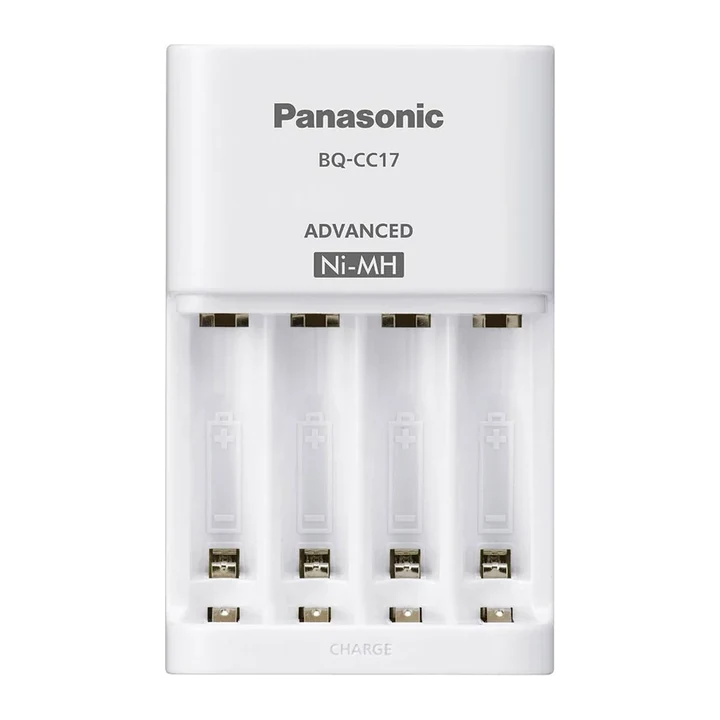
Panasonic Eneloop BQ-CC17 - gentlest, best for longevity
~$18-22BQ-CC17 · 4 independent slots · AA/AAA NiMH · slow charge
A slow charger, and that's the point - the gentlest option treats cells the best and squeezes out maximum cycle life. Choose this if you charge overnight and never need cells in a hurry.
Pros
- Gentle low-current charging = longest cell life
- Independent slots, proper termination
- Cheapest Eneloop-brand option
Cons
- Slow (not for same-day turnaround)
- Single LED per slot, no data
Best budget & multi-size
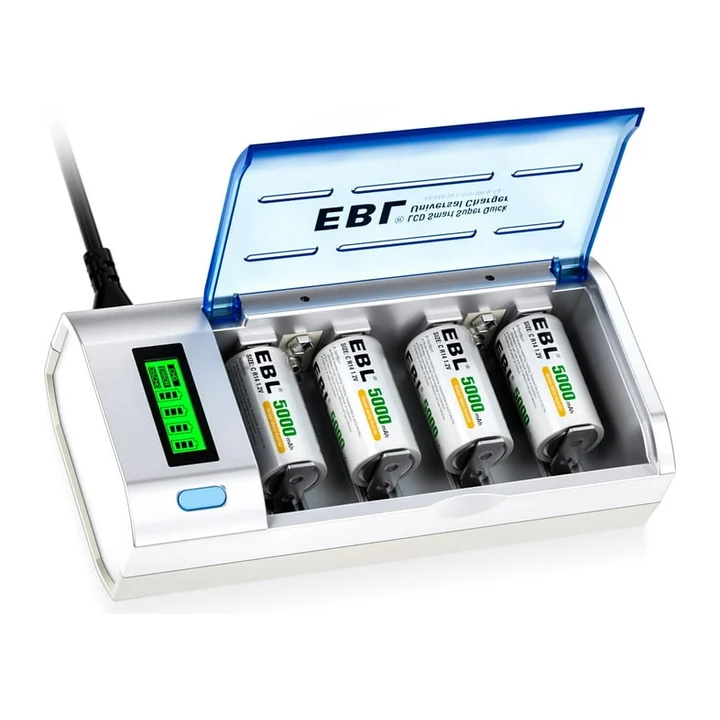
EBL 906 - if you need C, D, or 9V too
~$25-35Charges AA/AAA/C/D NiMH + 1-2× 9V · LCD · discharge/refresh
Not in the Panasonic quality class, but it's the easy answer when you have C, D, or 9V cells to charge - sizes the Eneloop chargers don't take. Has smart termination and a refresh function. Fine for casual use.
Pros
- Handles C / D / 9V as well as AA/AAA
- LCD + discharge/refresh
- Inexpensive
Cons
- Less precise termination than Panasonic
- More unit-to-unit variance
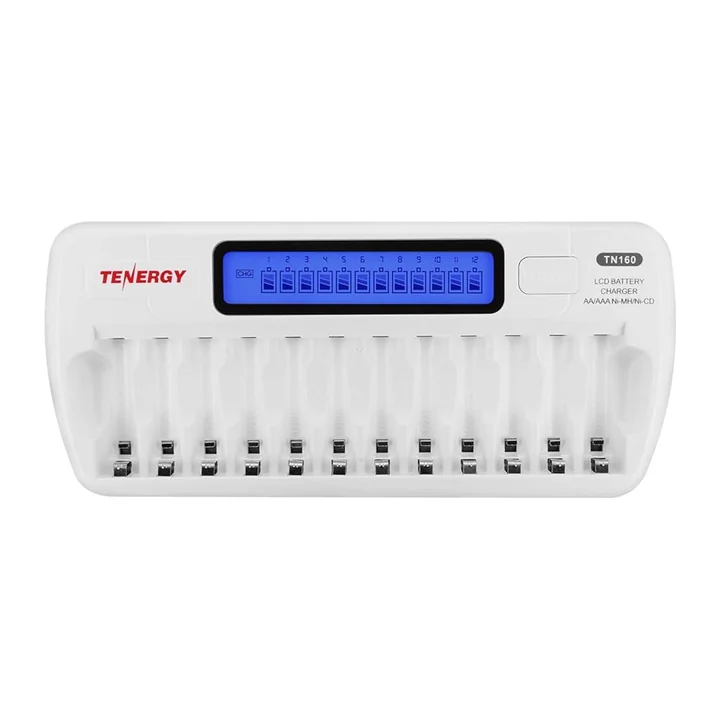
Tenergy TN160 - 12 bays for high-volume households
~$30-4012 independent channels · AA/AAA NiMH/NiCd · LCD · refresh
Twelve independent channels - genuinely per-bay, not paired - so you can dump a big pile of mixed AA/AAA cells in at once. The pick if your family goes through a lot of batteries and you're tired of charging four at a time.
Pros
- 12 independent bays, mix AA/AAA freely
- Per-battery LCD status + refresh
- Great throughput for the price
Cons
- Budget build quality
- Bulky; NiMH/NiCd only
Best analyzing charger (NiMH)
An analyzing charger discharges a cell fully and recharges it to report its true measured capacity in mAh - the only reliable way to find the tired cell dragging down a set. These are NiMH/NiCd only.
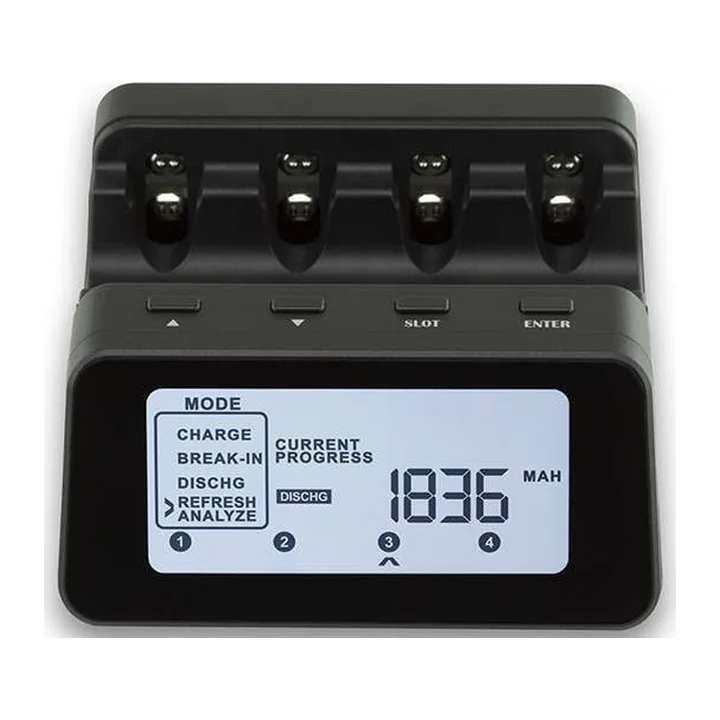
Powerex MH-C9000PRO (Maha)
~$75-904 independent slots · AA/AAA NiMH/NiCd only · Charge / Break-In / Discharge / Refresh-Analyze
The go-to dedicated NiMH analyzer. Four fully independent slots with a big per-channel LCD and manual control of charge/discharge current. Break-In runs the proper IEC forming cycle for new or long-stored cells; Refresh & Analyze reports true capacity. If you care about your NiMH cells and don't need Li-ion, this is it.
Pros
- Accurate true-capacity measurement
- Break-in, refresh, per-slot manual current
- Bulletproof reputation
Cons
- No Li-ion support
- No PC/graph logging
- Pricey vs a plain smart charger
Best Li-ion / multi-chemistry charger
If you own flashlight, e-bike, or power-tool cells (18650, 21700, 20700…) and want one charger that also does AA/AAA NiMH, get one of these. They auto-detect chemistry per slot.
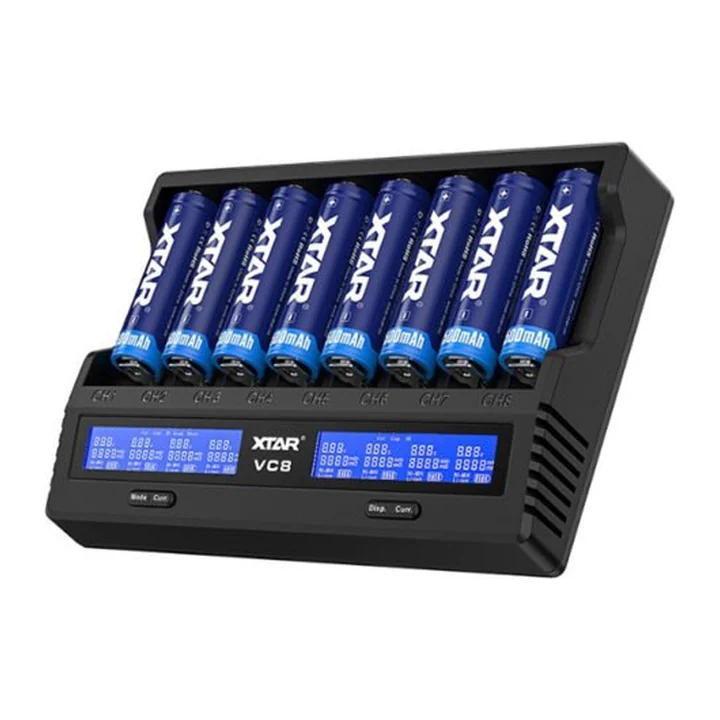
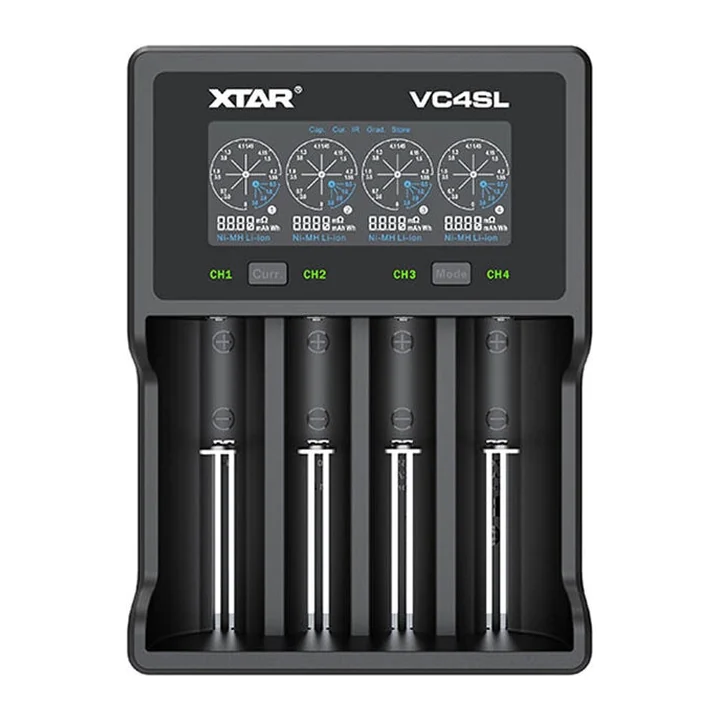
XTAR VC8 / VC8S (8-slot) & VC4SL (4-slot)
~$30-60Li-ion 10440→21700 + NiMH AA/AAA/C · LCD (V/A/capacity/IR) · capacity test · USB-C (VC8S: PD3.0)
The flashlight community's default. Charges Li-ion and NiMH, per-slot, with an LCD showing voltage, current, internal resistance, and measured capacity. The VC8/VC8S give you 8 slots (great for 18650 collections); the VC4SL is the compact 4-slot. In independent testing XTAR units run cooler than the comparable Nitecore - a real plus for cell longevity.
Pros
- Li-ion + NiMH in one, per-slot detection
- Capacity test + internal-resistance readout
- Runs cool; USB-C input
Cons
- Analyze features less deep than a true analyzer
- 8-slot version is chunky
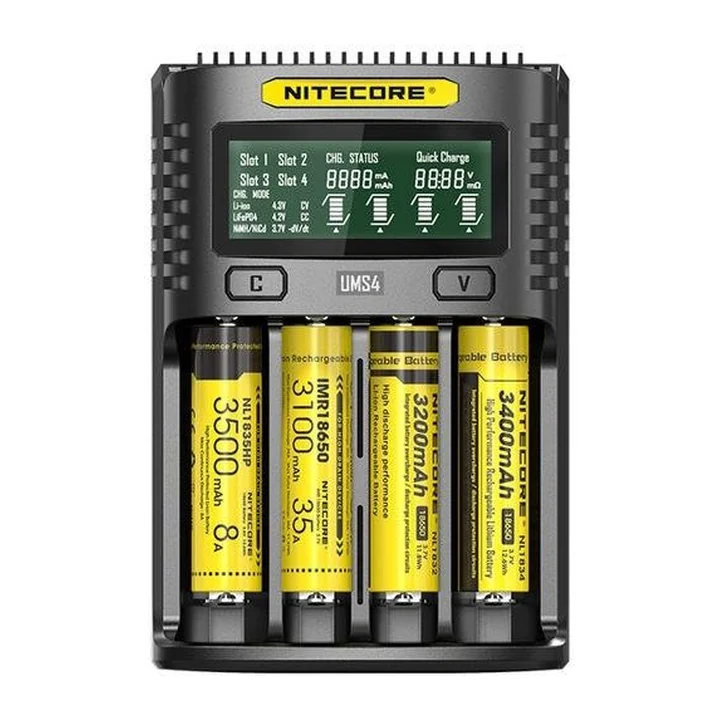
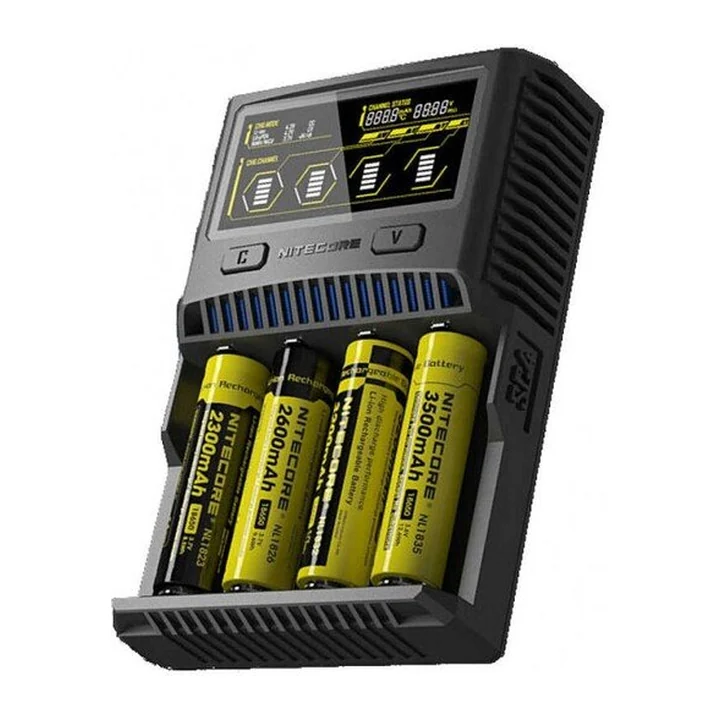
Nitecore UMS4 / SC4 - wide compatibility, fast
~$35-54Li-ion 10440→26650/21700 + NiMH/NiCd AA/AAA/C/D · LCD · up to 3A/slot
Very broad cell compatibility and fast (up to 3A on a single slot). Excellent if you charge big high-capacity Li-ion cells. Two cautions: pick a lower current for small or NiMH cells (the default is aggressive), and older UMS4 units use Micro-USB and run warmer than the XTAR.
Pros
- Huge cell-size compatibility
- Fast; clear LCD; USB output on SC4
Cons
- Runs warmer than XTAR in tests
- Default current too high for AAA/small Li-ion
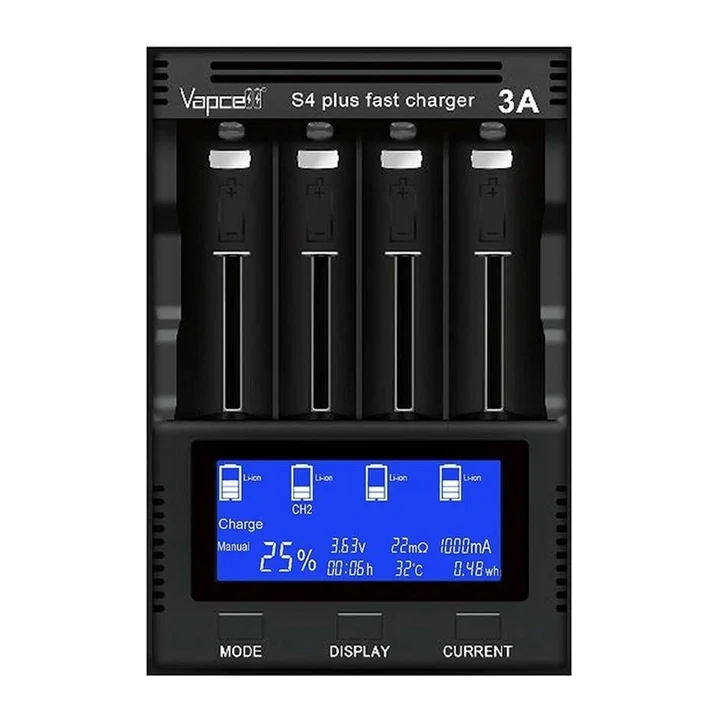
Vapcell S4 Plus - budget multi-chemistry analyzer
~$45-55Li-ion 16340→21700 + NiMH AA/AAA · capacity/analyze · IR test · refresh · manual current
Does most of what the high-end SkyRC does - capacity analysis, refresh, manual charge/discharge current, per-bay numbers - for under half the price. The value pick if you want data across both chemistries without going full enthusiast.
Pros
- Analyze + refresh on Li-ion and NiMH
- Manual current control
- Excellent value
Cons
- IR readings only roughly accurate
- No Bluetooth/app
Best do-everything charger (enthusiast)
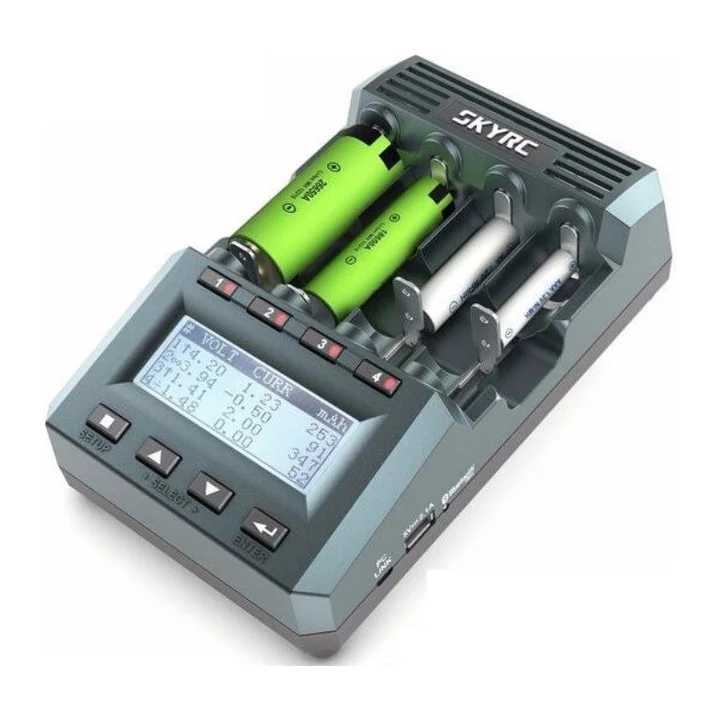
SkyRC MC3000 (and newer MC5000)
~$130-1654 independent slots · NiMH/NiCd/Li-ion/LiPo/LiFePO4/NiZn + more · Bluetooth + PC graphing · up to 3A/slot
The programmable everything-charger. Full manual control of charge rate, rest time, discharge rate, and cutoff voltage, with Bluetooth/PC apps that plot the curves - and firmware updates that add new chemistries over time. HKJ (lygte-info.dk) rates it as the best non-professional charger for cylindrical NiMH, partly because it tolerates high-internal-resistance cells and can revive old batteries other chargers reject. Overkill for most; heaven for tinkerers. The newer MC5000 adds an internal power supply and fits 21700 more easily.
Pros
- Every chemistry, full manual control
- Graph logging via app/PC
- Revives cells other chargers won't touch
Cons
- Expensive, big, external PSU (MC3000)
- Steep learning curve
All picks compared
| Charger | Best for | Chemistry | Slots | Analyze? | ~Price |
|---|---|---|---|---|---|
| Panasonic BQ-CC55 | Most people | NiMH | 4 indep. | No | $20-27 |
| Panasonic BQ-CC65 | Data + USB out | NiMH | 4 indep. | No | $35-45 |
| Panasonic BQ-CC17 | Longevity / gentle | NiMH | 4 indep. | No | $18-22 |
| EBL 906 | C / D / 9V sizes | NiMH | 4 + 9V | Refresh | $25-35 |
| Tenergy TN160 | High volume | NiMH | 12 indep. | Refresh | $30-40 |
| Powerex MH-C9000PRO | NiMH analysis | NiMH | 4 indep. | Yes | $75-90 |
| XTAR VC8 / VC4SL | Li-ion + NiMH | Multi | 8 / 4 | Capacity | $30-60 |
| Nitecore UMS4 / SC4 | Big Li-ion, fast | Multi | 4 indep. | Capacity | $35-54 |
| Vapcell S4 Plus | Budget analyzer | Multi | 4 indep. | Yes | $45-55 |
| SkyRC MC3000 | Do everything | Multi | 4 indep. | Yes+graph | $130-165 |
⚡ Not sure which one fits your batteries?
Answer three questions and the Charger Finder narrows it down for you.
Open the Charger Finder →Prices and availability are approximate and change constantly - confirm before buying. Model recommendations reflect current community consensus and independent testing (notably lygte-info.dk and eneloop101) as of mid-2026. Some finer specs (exact prices, current model revisions) should be double-checked against manufacturer pages.